The Story
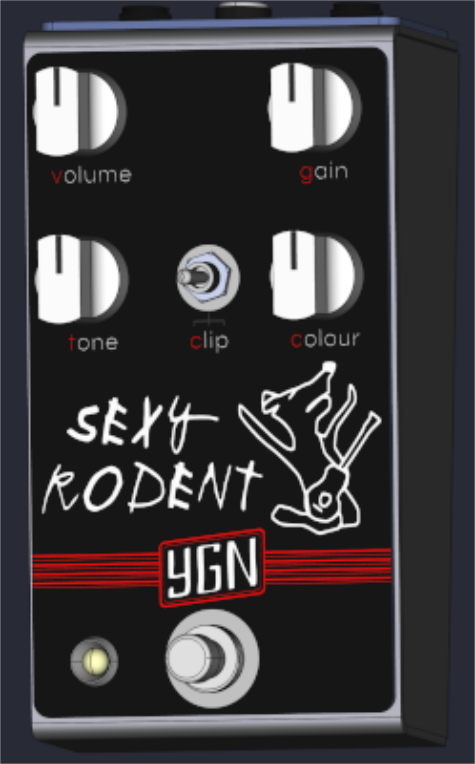
Controls
Front Panel
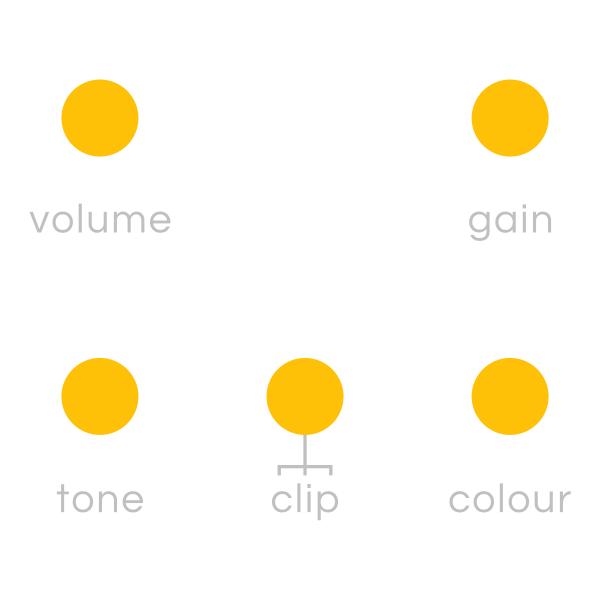
Volume
Sets the output level. The available level varies with the selected clipping mode, with LED clipping leaving considerably more output on tap than silicon or germanium.
Gain
Sets the gain of the op-amp stage and covers a wide range, from mild overdrive through distortion and into fuzzier territory. Its response interacts with Sweep, since Sweep changes part of the feedback network that determines the stage's frequency-dependent gain. The clipping mode also has a large effect on the result. Lower-threshold diodes reach clipping earlier, while LEDs allow a larger signal swing before the clipping stage starts limiting it.
Tone
Controls the post-clipping low-pass filter. Turning it clockwise lowers the cutoff frequency and removes progressively more high-frequency content.
Sweep
Adjusts the frequency response of the op-amp gain stage using a variable implementation of the Ruetz mod. The stock RAT feedback network contains two frequency-dependent branches. Sweep acts on the higher of the two, built around a 47 Ω resistor and 2.2 µF capacitor, with a corner frequency of roughly 1.5 kHz. The control adds up to approximately 1 kΩ in series with that resistor. Fully counter-clockwise gives the stock 47 Ω value. Turning Sweep clockwise increases the resistance and progressively lowers that corner frequency, reaching roughly 70 Hz at the other end of the control. This allows more low-frequency content into the high-gain region of the circuit. Increasing the resistance also reduces the gain contributed by that branch, so Sweep changes the frequency response and gain structure together. This interaction is a large part of the control's range and is worth exploring alongside Gain.
Clip
Selects the clipping diodes between silicon, LED and germanium. Silicon gives the familiar stock-style clipping. LEDs have a higher forward voltage, allowing a larger signal swing before clipping and producing more output with less diode compression. Germanium has the lowest clipping threshold of the three, producing earlier clipping, more compression and a lower output level. Since the op-amp gain stage remains unchanged, the switch gives three different responses from the same underlying circuit.
Internal Controls
Effect Board
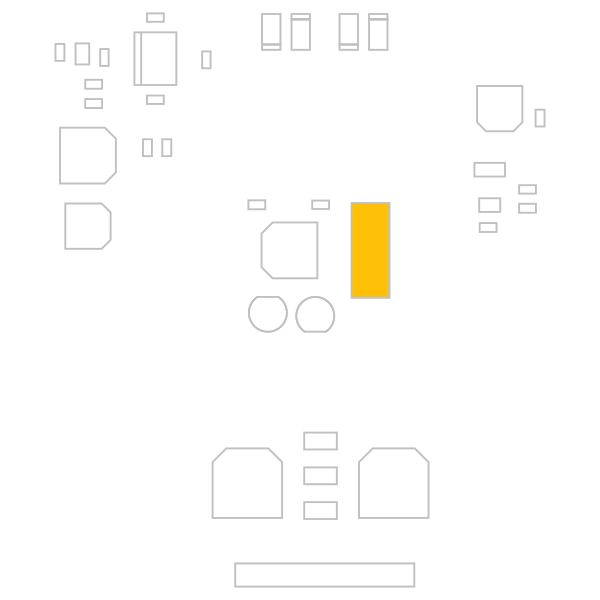
Mellow
Adds a capacitor at the clipping stage to roll off some of the higher-frequency content generated by the distortion. Enable it for a slightly smoother, less aggressive top end.
IO Board
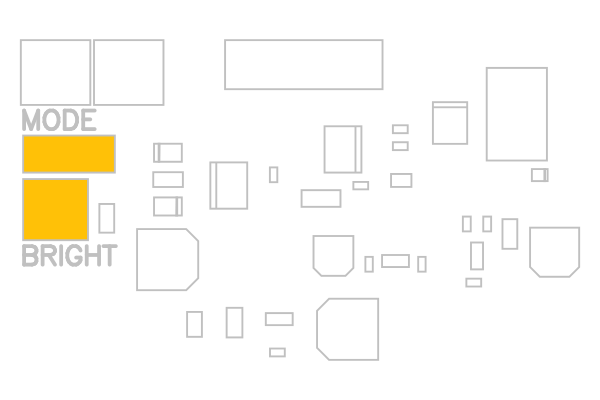
Mode
Sets the power-on state of the pedal. With the DIP switch set to the ON position, the effect starts active.
Bright
Adjusts the brightness of the status LED.